A town hall with deep local roots
- Year: 2025
- Location: Tafers (CH)
-
Type:
Competition


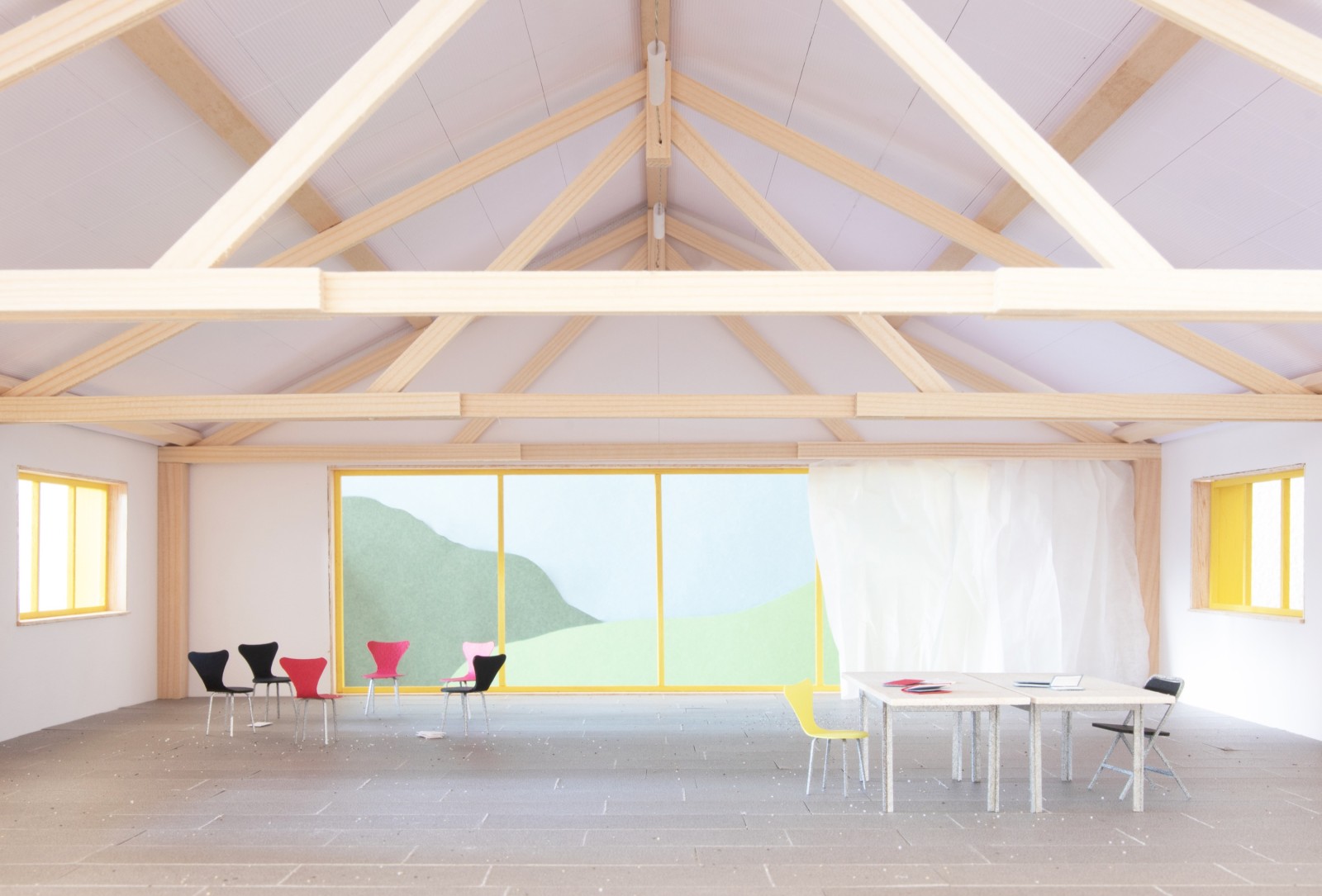


Poppeliwiize is a new building designed for the residents of Tafers, Alterswil, and Sankt Anton, embodying a sustainable vision for society. Its architecture highlights regenerative materials and short supply chains, drawing direct inspiration from the rural world that has shaped the local landscape. Positioned perpendicular to the slope, the structure presents a gable façade scaled to the village along the main road. A composition of raw materials, colorful details, and technical equipment adorns the façades, inviting exploration. Two longitudinal entrances, guided by a long canopy, ensure a seamless connection with the Tafers administration building, while a tree-lined public path leverages the bucolic atmosphere near the neighboring farm.
Construction prioritizes solid spruce sourced from communal forests, locally processed for the structure, cladding, and flooring, thereby promoting biogenic carbon storage. Earth excavated is repurposed: part of it is transformed on-site, with resident participation, into compressed earth blocks (CEB) for vaults, while the remainder is processed industrially at a nearby plant. This earthen mass provides excellent thermal inertia and natural humidity regulation. Insulation is provided by rectangular straw bales harvested from nearby fields, easily integrated into wooden frames. Finally, shelly sandstone from the La Molière quarry (37 km away) clads the flooring in circulation areas, custom-cut to minimize waste.
The load-bearing system relies on a solid wood post-and-beam structure, granting the floor plan significant adaptability for future uses. The three-bay column arrangement allows for a 6.3-meter span using regional elements typically limited to 5 meters. Horizontal stability is ensured by self-supporting façades made of prefabricated wooden boxes filled with straw. The roof structure, also crafted from laminated solid wood, supports a generous overhang via a purlin, echoing the aesthetic of traditional barns.
A straight staircase offers an intuitive reading of the building, progressively revealing the functions of each floor. Common spaces extending from the landings encourage cross-functional interaction. The ground floor hosts the lobby, public administration offices, and archives (partially underground); the first floor groups social services, associations, and an apartment; the second is dedicated to municipal services. The top level offers a prime location for a large hall and a café with a terrace, situated beneath a wide roof with exposed timber framing.
Energetically, the building is highly efficient: photovoltaic panels cover the south-facing roof slope and frame the windows on the same façade. Straw insulation ensures effective thermal phase shift, maintaining summer coolness, complemented by external solar shading. Well-insulated, the building requires minimal heating, provided by responsive radiators connected to the district heating network.
Project team: Elias Taillebois, Jean-Michaël Taillebois, Sébastien Tripod
In collaboration with:
Civil engineering: Olivier Francey
Straw construction expert: Élodie Simon
Model assistance: Sandy Eberlach